


 English
  русский
  Español
Home / News / Industry News / Plain Webbing vs Jacquard Webbing: How Weave Structure Affects Pattern, Stiffness & Fit

Industry News
Sep 04,2026
Plain Webbing vs Jacquard Webbing: How Weave Structure Affects Pattern, Stiffness & Fit
Content
When a product developer specifies a 38mm webbing strap for a technical backpack, the first decision is not color or material. It is the choice between plain webbing vs jacquard webbing. The same polyester yarn can be woven into a dense plain weave that resists stretching and holds its shape under load, or it can be arranged with warp floats that turn the tape into a seven-color brand statement. That structural choice changes pattern capability, bend stiffness, and the way the tape behaves when a sewing operator feeds it through a bartack station.
For a webbing manufacturer like Jiangyin City Baihong Weaving Band Co., Ltd that has produced both structures since 2008, the difference is measurable on every order. The distinction between plain and jacquard webbing is not decorative; it is a functional engineering parameter that dictates what can be achieved after the tape leaves the loom.
Plain Webbing vs Jacquard Webbing: Weave Structure Limits Pattern Complexity
Plain weave caps you at approximately 1-2 colors per repeat, while jacquard structure allows unlimited multi-color pattern production within a single woven repeat.
In a plain weave, every warp end passes over one weft pick and under the next, creating a tight 1/1 interlacing grid. The only way to introduce pattern is to vary yarn colors in the warp or weft, which limits you to stripes, checks, and subtle textured effects. If a garment brand requests a woven logo, a geometric motif, or a multi-color seasonal design, the mill must instead place warp ends under individual jacquard control.
Jacquard harnesses control each warp end separately, allowing yarns to float over several weft picks before being locked back into the structure. This produces complex surface designs with crisp color separation. The practical limit is the number of harness frames and tape width, not the weave structure.
Core Concept
Plain webbing uses a 1/1 interlacing pattern where each warp passes over one weft and under the next. Jacquard webbing uses individually controlled warp ends so selected yarns float over multiple picks, creating higher pattern complexity with reduced interlacing density.
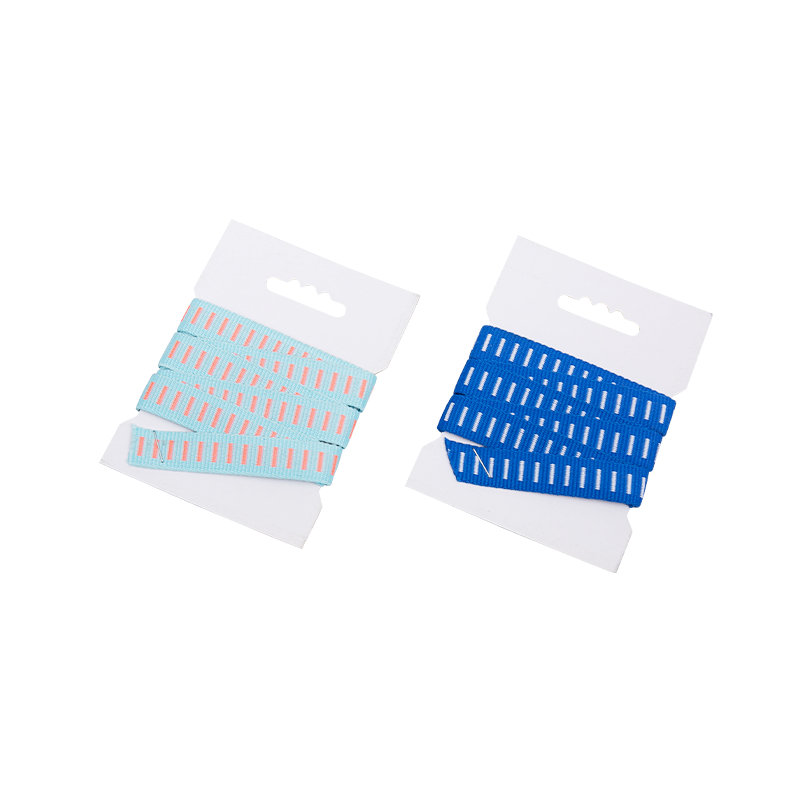 Jacquard Polyester Webbing with Intricate Patterns and ColorfastnessThis webbing suits apparel brands needing custom-patterned trims. Its jacquard weave allows complex designs, while the polyester ensures color retention even after sun exposure and washing, making it ideal for export-quality accessories.View Product →
Baihong introduced computer jacquard looms in 2008 to serve garment and footwear brands requesting custom-patterned trims. Since then, the same machinery has produced jacquard polyester webbing for export to Europe and the United States, where brand owners order woven logos and seasonal designs in small batch quantities. The trend has become so established that jacquard webbing is seeing a surge in global demand across the apparel supply chain.
Plain Webbing vs Jacquard Webbing: Stiffness Difference
Plain webbing is measurably stiffer than jacquard webbing at the same material basis weight, because the 1/1 structure produces more crimp interlock per square centimeter.
Every time a warp yarn crosses a weft yarn, both yarns bend slightly out of plane. This crimp locks the yarns together and creates resistance to bending. In plain weave, nearly every crossing is an interlacing point, so the fabric is stiff and dimensionally stable. In jacquard weave, warp floats bypass several weft picks, reducing the number of interlacing points and allowing the tape to flex more freely.
| Attribute | Plain Webbing | Jacquard Webbing |
| Interlacing density | Maximum, 1/1 grid | Reduced in float zones |
| Crimp level | High | Moderate to low |
| Flexural rigidity | High | Medium |
| Width stability | Excellent | Good |
| Surface feel | Firm and compact | Softer in pattern areas |
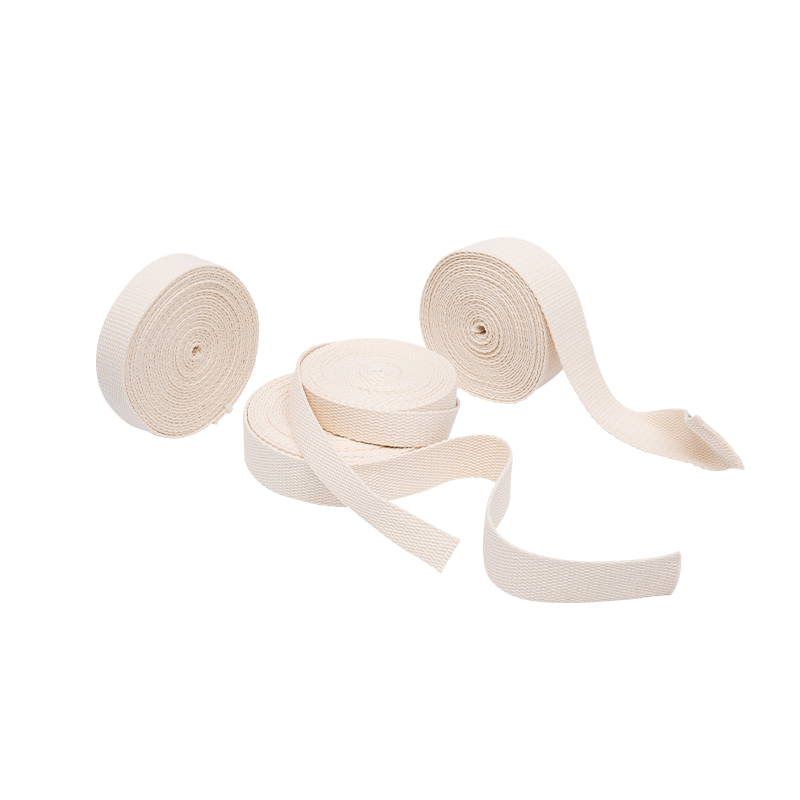 Plain/Flat Cotton Webbing in Various Weave Densities for Diverse UsesThis cotton webbing offers a flat, tough surface and soft feel. Available in fine, coarse, or sparse plain weaves, it provides options for strength, durability, or lightweight use across bags, shoes, and outdoor gear.View Product →
This stiffness difference matters during cutting, edge finishing, and fold-over sewing. Tight plain webbing can be die-cut cleanly and supports heavy loads without deflection. Softer jacquard webbing drapes against curved seams and lies flatter against garment panels, which is preferred in decorative trim and hatband applications.
Application Fit: Choosing the Right Weave Structure
Choose plain webbing for load-bearing straps that need flexural rigidity and width stability. Choose jacquard webbing for decorative or branded applications where surface aesthetics outrank drape.
The clearest way to understand the fit is to look at what fails in the field. A backpack shoulder strap made from soft jacquard webbing stretches under load and the buckle holes deform. A decorative trim made from stiff plain webbing puckers when sewn around a curved collar. The weave structure must match the mechanical demand of the end product.
Plain Webbing Applications
- Belt webbing and waistband support
- Backpack straps and load-bearing handles
- Mattress webbing and industrial lifting tapes
- Reinforced flat laces that need to hold a knot
Jacquard Webbing Applications
- Woven logos and branded shoelaces
- Fashion trims and decorative ribbons
- Elastic webbing with patterned knit effects
- Garment tapes that must curve along seams
 EVA Foam Road Bike Handlebar Tape with Anti-Slip SurfaceDesigned for road bikes, this EVA tape includes two pieces per set. Its anti-slip texture and 3M adhesive ensure secure grip and attachment, while foam cushioning reduces hand pressure during long rides.View Product →
The same split applies to footwear. A webbing manufacturer that supplies both plain and jacquard structures can help a shoe brand decide whether a patterned elastic band should support the instep or simply present a logo. When the pattern must stretch around the foot, jacquard elastic webbing is the correct structure, because the float zones provide the flex needed for a secure fit.
Cost, Lead Time, and Supply Risks to Price In
Jacquard webbing typically runs 15-40% higher per meter than plain webbing of the same material and width, because loom speeds are slower and warp preparation is more complex.
A plain weave can be set up on a standard narrow-weave loom with two to four harness frames. A jacquard pattern requires a computer to drive hundreds of individual warp hooks, plus design digitization and a trial run.
15-40% Cost premium per meter
~50% Slower weaving speed
5-7 days Pattern development
2x Warp preparation time
On the production floor, jacquard looms run at roughly half the speed of plain-weave looms for the same width. The result is a per-meter cost premium that must be passed to the customer. For branded products carrying a woven logo, the premium is usually acceptable because the alternative, embroidered labels or printed appliques, costs even more per unit.
Relative Performance Profile: Plain vs Jacquard
Pattern complexity
Stiffness
Production speed
Cost per meter
Plain weaving Jacquard weaving
Scale: 0-10, where 10 is the highest level for the indicated property.
Decision Framework for Selecting Weave Structure
Your specification decision should be driven by three questions: dimensional stability requirement, visual design complexity, and acceptable batch quantity.
If the fiber content, width, and breaking strength are already fixed, the weave structure becomes the lever you can still pull. The framework below turns that lever into a repeatable decision.
1
Define the mechanical load. If the webbing will support any weight, start with plain weave.
2
Map the visual requirements. If the design includes a logo or multi-color pattern, jacquard is mandatory.
3
Check the cost ceiling. Calculate the plain-webbing baseline, then apply the jacquard premium.
4
Confirm the minimum quantity. Jacquard runs are typically longer because setup is amortized over more meters.
Practitioner Note
Request a 30cm pattern sample from your supplier before committing to production. It costs a fraction of the full trial and gives you an accurate read on drape, stiffness, and color placement.
FAQ
Does jacquard webbing wear less durable than plain webbing?
Not necessarily. A jacquard structure with short floats wears almost as well as a plain weave. The risk appears when long warp floats create snagging points. A responsible webbing manufacturer will control float length in the design phase to balance pattern complexity with abrasion resistance.
Can plain webbing have a woven logo?
Yes, but with severe limitations. You can produce a small logo with a dobby mechanism using extra warp ends, typically in one or two colors. For a multi-color corporate mark, a jacquard loom is the practical option.
What batch quantity is practical for jacquard webbing?
Practical minimum order quantities vary by width and loom configuration. As a rule of thumb, 500 to 1000 meters is the lowest range for a custom jacquard pattern on narrow webbing, while 300 meters is often sufficient for a plain weave. Confirm with your supplier before quoting.
Can plain and jacquard webbing be made with the same yarn material?
Yes. Both structures can be woven from cotton, polyester, polypropylene, nylon, or recycled polyester. The same yarn often behaves differently in each structure, a soft cotton yarn produces a more compact handle in plain weave and a more decorative surface in jacquard.


Over the years, we have been providing high-quality, safe and reliable products for the clothing and footwear industries.
- Quick Links
- Contact Information
-
-
 NO.137-1 Chenglu Road, Huashi Town, Jiangyin City214421, Jiangsu, China
 -
 +86 138-0616-9220
 -
 Lhbhzd@126.com
bh@jyribbon.com
sales2@jyribbon.com
-
- Mobile QR Code

