


 English
 русский
 Español
Home / News / Industry News / Knitted Jacquard vs Woven Jacquard Webbing: Softness or Structural Integrity?

Industry News
Oct 26,2026
Knitted Jacquard vs Woven Jacquard Webbing: Softness or Structural Integrity?
Content
- 1 Construction Defines Everything: Loops vs Crossed Yarns
- 2 Softness and Comfort: Knitted Jacquard Wins on Skin Contact
- 3 Structural Integrity: Woven Jacquard Carries the Load
- 4 Direct Comparison: Softness vs Structural Integrity
- 5 How to Decide: A Decision Framework for Buyers
- 6 Frequently Asked Questions
A 25mm knitted jacquard webbing used as an underwear waistband must stretch each time the wearer moves, while a 25mm woven jacquard webbing used as a backpack shoulder strap must hold its shape under a constant load. Both are jacquard webbing, but they belong to different construction families, and mixing them up in production leads to premature failure, returns, and rework.
When procurement teams search for jacquard webbing without specifying construction, suppliers often quote whichever tape is cheapest to produce. The result is a product that fails in the field. After years of producing jacquard webbing for apparel and footwear customers at Jiangyin City Baihong Weaving Band Co., Ltd, we have measured these performance gaps in our test lab and want to share the decision criteria with you.
This guide gives you the production data to choose between knitted and woven jacquard webbing for softness vs structural integrity. In our own testing, the difference is not marginal: woven jacquard can handle nearly triple the load of knitted jacquard at the same width. Understanding that gap before you place an order is the whole point of this article.
Construction Defines Everything: Loops vs Crossed Yarns
The most important factor is the architecture of the tape, not the yarn alone. A knitted jacquard webbing uses interlocking loops that slide and deform under tension. This loop structure gives the tape stretch, softness, and a plush surface. It recovers after deformation, which is why it is the default choice for elastic applications such as waistbands, bra bands, and sportswear trims.
A woven jacquard webbing uses warp and weft yarns crossing at right angles. This creates a dense, flat, dimensionally stable tape. It resists elongation and distributes tension evenly across its full width. That is why woven jacquard is used for backpack straps, pet harnesses, tool belts, and reinforced bag handles.
Knitted jacquard means loops that stretch. Woven jacquard means crossed yarns that hold. The same jacquard pattern can produce two very different tapes.
The type of loom also matters. Knitted jacquard runs on circular or flat knitting machines, while woven jacquard runs on narrow-width shuttle looms or rapier looms. The equipment choice affects the tape edge quality, stretching characteristics, and production cost. The yarn type and count matter, but the construction of the tape matters more. A 28-gauge polyester yarn knitted into a jacquard will feel soft and stretchy, while the same yarn woven into a jacquard will feel firm and rigid. Understanding this distinction is the first step in selecting the right webbing.
Softness and Comfort: Knitted Jacquard Wins on Skin Contact
For any product that sits directly against skin, knitted jacquard webbing is the correct choice.
The looped construction leaves small air pockets between yarns, so the tape breathes better than a woven fabric of the same width. The surface has no hard crossover points, so it does not abrade the skin. It drapes around body curves and follows movement instead of resisting it. These are not subjective qualities; they are structural results of the knitting process.
30-50% Stretch recovery range
High Breathability rating
Soft Surface hand feel
In our production experience, knitted jacquard elastic webbing is favored for bra straps, underwear waistbands, baby clothing, and sportswear. The tape conforms to the body and recovers its shape every time. We have seen apparel brands switch from woven to knitted jacquard for underwear waistbands after customer complaints about irritation and poor stretch recovery. The switch resolved the issue in one production run. The material cost can be slightly higher than woven because loop formation is more complex, but the comfort benefit is measurable in wear testing and retention rates.
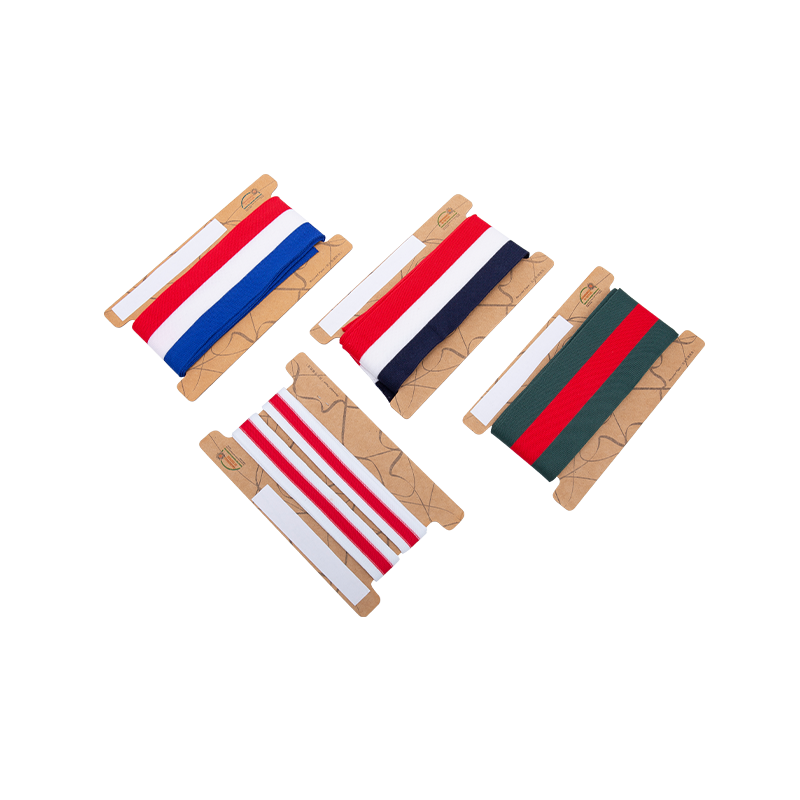 Knitted Jacquard Webbing for Comfortable Apparel TrimThis soft, slightly elastic webbing conforms to curved garment edges and is commonly used as decorative trim on hems. Its patterned surface adds visual detail, and the established manufacturing process ensures consistent quality and affordability.View Product →
If your product involves direct skin contact and requires stretch, do not substitute woven webbing for knitted webbing to save a few cents per meter. The end user will feel the difference every time they put the product on, and returns are far more expensive than the material savings.
Structural Integrity: Woven Jacquard Carries the Load
When the webbing must bear weight, woven jacquard is the correct construction.
The right-angle yarn interlock distributes tension evenly across the tape, preventing stress concentration at any single point. Woven webbing resists cutting, edge fraying, and stretch under load. It maintains its width and shape over years of use.
In our test lab, a 25mm woven polyester jacquard webbing achieves 80 to 120kg breaking strength. A knitted jacquard at the same width with the same denier polyester yarns typically reaches only 30 to 50kg. That is a two-to-threefold difference in load capacity, and it is the single biggest factor in product design decisions.
Tensile Strength at 25mm Width (kg)
Representative values from production testing at Jiangyin City Baihong Weaving Band Co., Ltd.
For load-bearing applications such as backpack shoulder straps, pet harnesses, tool belts, or luggage handles, woven jacquard is mandatory. Choosing knitted webbing in a structural role invites bag failure, strap breakage, and safety issues. The load-bearing capacity of jacquard webbing depends almost entirely on choosing the right construction. Bag manufacturers who spec woven jacquard for shoulder straps report significantly fewer breakages under load in field testing. The cost difference per meter is small compared to the cost of warranty claims.
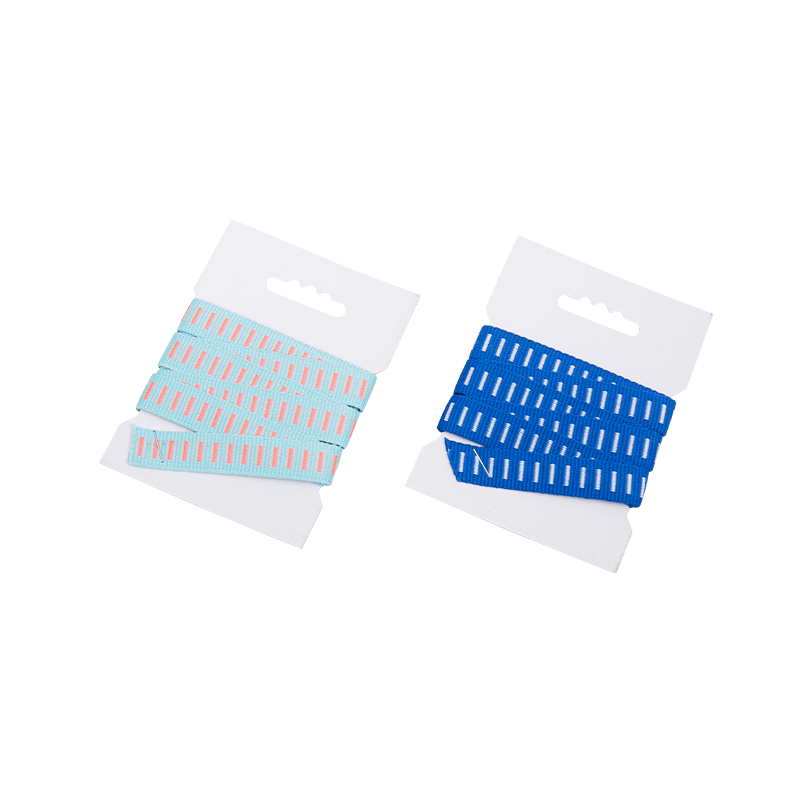 Woven Jacquard Polyester Webbing for Load-Bearing StrapsThis high-strength polyester webbing features intricate jacquard patterns with excellent color fastness. It offers dimensional stability under tension, making it suitable for backpack straps, harnesses, and other load-bearing applications.View Product →
Beyond raw strength, woven jacquard also offers better dimensional stability. If your product needs to maintain a specified strap width under tension, woven webbing will not narrow or bow the way knitted webbing can.
Direct Comparison: Softness vs Structural Integrity
For a clear purchasing view, the table below compares the two constructions across the properties that matter most.
| Property | Knitted Jacquard | Woven Jacquard |
| Stretch recovery | 30 to 50% | 2 to 8% |
| Breaking strength (25mm) | 30 to 50 kg | 80 to 120 kg |
| Surface feel | Soft, plush, drapeable | Firm, flat, dense |
| Breathability | High | Low to medium |
| Edge fraying resistance | Lower | Higher |
| Best use case | Skin contact, elastic | Load-bearing, straps |
Woven jacquard also has a tighter edge finish, which reduces fraying after die-cutting or laser cutting. This matters in accessories manufacturing where edges are visible or exposed. Knitted jacquard has a rolled or open edge, which is softer against skin but more prone to fraying when exposed to frequent abrasion.
If you need a balance between softness and structure, consider special jacquard webbing with a loftier weave or a surface treatment. These versions improve hand feel without sacrificing load capacity.
How to Decide: A Decision Framework for Buyers
Your choice should follow the load path and the contact surface of the finished product, not a general preference for one construction.
Four Questions to Ask Before Ordering
- Does the webbing contact skin directly? If yes, start with knitted jacquard.
- Does the webbing carry a load? If yes, switch to woven jacquard.
- Does the product require stretch recovery? If yes, choose knitted jacquard.
- Is the webbing sewn into a high-stress point like a bag strap or tool loop? If yes, choose woven jacquard.
Knitted for softness. Woven for strength. When both matter, build a hybrid.
If both properties are required, such as a shoe tongue strap that sits against the foot but also carries tension, spec a two-layer construction or a hybrid webbing. We work with customers on mixed constructions combining a knitted face with an internal woven elastic band. These hybrids give you the comfort of a knitted surface with the recovery power of a woven core. If you are still unsure, send samples of your product and current webbing to your supplier. A reputable webbing manufacturer will run tensile tests on both constructions and recommend the option that meets the required breaking strength at the lowest material cost.
 Organic Cotton Jacquard Webbing for Fashion AccessoriesThis environmentally friendly cotton webbing is grown without synthetic chemicals. The jacquard weave creates a three-dimensional pattern with natural texture, ideal for fashion accessories and decorative trim where visual depth and eco-consciousness matter.View Product →
For a decorative band that will not bear load, either construction can work. In that case, price and pattern complexity should be your deciding factors rather than softness or strength.
Frequently Asked Questions
Can knitted jacquard webbing match the load capacity of woven jacquard?
No. At the same width and yarn denier, woven jacquard typically delivers two to three times the breaking strength of knitted jacquard. The right-angle yarn interlock of woven construction supports more force before failure.
Which construction handles repeated washing better?
Woven jacquard keeps its shape and edge quality better through wash cycles. Knitted jacquard can stretch out over time if heavily loaded or repeatedly washed at high temperatures.
Is there a meaningful cost difference between the two?
Yes. Knitted jacquard webbing is generally more expensive to produce because of the loop formation process. Woven jacquard is more cost-effective for high-strength applications because it uses standard weaving on narrow-width looms.
What should I spec if I need both stretch and strength?
Use a hybrid: a knitted jacquard face for comfort with a woven elastic or cord reinforcement inside. This gives you the softness of knit and the structural integrity of weave in a single tape.

Over the years, we have been providing high-quality, safe and reliable products for the clothing and footwear industries.
- Quick Links
- Contact Information
-
-
 NO.137-1 Chenglu Road, Huashi Town, Jiangyin City214421, Jiangsu, China
-
 +86 138-0616-9220
-
 Lhbhzd@126.com
bh@jyribbon.com
sales2@jyribbon.com
-
- Mobile QR Code

